Sunday, 27 May 2018

The Joy of Reading - A Recipe for Student Success

One of the main reasons I told myself I would never teach early primary was because of reading. Teaching a child to read is a huge responsibility and it terrified me. Now I find myself immersed in teaching Kindergarten and trying to learn the best way to: A. teach my students how to read and B. help them to love reading and be read to.

As an avid reader it is second nature for me to pick up a book and just read. Many late nights can be blamed on the thought "just one more chapter." This is not the case for all of my students however, some of them are still learning how to read themselves, others are reading but are more motivated by the prize once they fill up their sheet than the love of their early reader leveled book.

For the early readers and non readers I believe the love of reading will come out of being read to. In Kindergarten some students will come to school already filled with a love of being read to but others might have less experience with this. I find that most students at this age love listening to books and are easily swept away by stories.

The topic of this blog post is Fostering A Reading Culture in our Schools. After thinking and searching a lot over the week I have decided that the main focus for myself as a K teacher is going to be access to quality picture books and an inviting reading space. Both of these ideas were presented to me through reading a variety of blogs. I have linked one to each of the two topics.

To ensure the success of students as they become readers, the classroom will also need to be print rich and the teaching of reading skills will need to be engaging and on level with the students. Those topics are also important but for space I will not comment further on those today.

A Cozy Reading Corner


I think we would all love to be able to have a reading corner that is inviting and filled with comfortable seating like this Poet's Tree corner found on the Pacon project website. Unfortunately there is not a lot of extra room in my classroom for a display like this. I think it is important that a classroom have inviting places for students to read no matter the size. This could be throw pillows, beanbag chairs, or a small tent. Having these special things will encourage students to get comfortable with a book. The books themselves should be presented in a way that makes them both appealing and easily accessible to students.

We are fortunate to have access through the internet to endless ideas about how to create such a space. While searching I came across a few websites that offer suggestions for a variety of class sizes. Here are a couple to start.

1.  Amazing Classroom Reading Corners
In this article five different teachers from a variety of grades document how they created their reading corner. A lot of them use themes which connect to a book the class studied.

2. Classroom Reading Nook Ideas
This is a compilation of 25 ideas for reading nooks. I like that there are a variety of styles and sizes. Photos are linked to the original websites.

Access to Quality Books

Once Students have areas that are suited to reading they will need a wide selection of books to read. This could include leveled readers, non-fiction, picture books, thematic books, and magazines. Even if students are not reading they should be able to choose from books with engaging illustrations and photos. There should also be a variety of books that the teacher can read to the class.

The Fraser Valley Regional Library has a brochure titled 100 Books to Read in Kindergarten. On their website they have linked each book and patrons can put these books on hold easily this way. This list gives any parent or teacher a place to start when looking to choose quality books to read out loud.

Another way to find quality books for reading out loud is to check out the book lists each year. Reviewers love to put out lists of their favourites such as this one from Brightly: 18 Must-Read Picture Books of 2018. Just looking at the covers and reading the brief descriptions made me want to stop typing and take a trip to the book store.

Conclusion

I will leave you with this video which talks about how to foster a reading culture in a school. I appreciate that the principal and teachers are giving examples of how they model a love of reading for their students. One of the teachers says of her students, "If I can teach them to love reading, they've got access to information for the rest of their lives." This school is setting a great example in regards to creating a school-wide reading culture. The excitement shown by school staff is echoed by the students which shows the school is having success with their model.


Works Cited

Gray, J. (2017). How to create the perfect reading environment in school. [online] One Education. Available at: https://www.oneeducation.co.uk/one-editorial/literacy/the-reading-environment/ [Accessed 26 May 2018].

Hopper, C. (2018). 10 Ways to Foster a Reading Culture in Your School - Classroom Chronicles. [online] Classroom Chronicles. Available at: http://tnclassroomchronicles.org/10-ways-foster-reading-culture-school/ [Accessed 26 May 2018].

Pacon. "Poet-Tree Corner." Pacon Projects, 2018, https://pacon.com/projects/poet-tree-corner.html?utm_source=pinterest&utm_medium=pin&utm_content=project.

Logue, C. (2018). Amazing Classroom Reading Corners | Scholastic. [online] Scholastic.com. Available at: https://www.scholastic.com/teachers/articles/teaching-content/amazing-classroom-reading-corners/ [Accessed 27 May 2018].

Lennert, N. (2013). Classroom Reading Nook Ideas. [online] Theclassroomcreative.com. Available at: http://www.theclassroomcreative.com/2013/09/classroom-reading-nooks-areas-ideas/ [Accessed 27 May 2018].

BiblioCommons. (n.d.). 100 Books to Read in Kindergarten - Fraser Valley Regional Library. [online] Available at: https://fvrl.bibliocommons.com/list/share/161293473/660088648?page=1 [Accessed 27 May 2018].

Corneal, D. (2018). 18 Must-Read Picture Books of 2018 | Brightly. [online] Brightly. Available at: http://www.readbrightly.com/picture-books-2018/ [Accessed 27 May 2018].

Sunday, 20 May 2018

Resources

To prepare for this blog post I reached out to my colleagues through our kindergarten Facebook page. I asked them to recommend Twitter feeds as well as blogs that I could read and follow. The possibilities are endless and I wanted to start with resources that other teachers were already using and having success with. Within a couple of hours I already had more suggestions than I need for this post and I am excited to take some time to get to know the blogs suggested. I also looked up a variety of articles and videos. It took a long time to narrow it down for this blog. At any given time I had 15 browser windows open on my PC. It is clear that there is a large variety of sources out there. Here are a few I will be going back to on a regular basis for my own teaching purposes.

 The Curious Kindergarten
This blog details one Kindergarten teacher's class over the years. I like how in the description she says that her blog is about the discoveries made by both her and her students. Each post details an activity completed in the class. There is a list on the side of common topics which makes it easy to find areas of interest. I clicked on the inquiry topic which opened up examples of how this teacher has used inquiry based learning in her class. As a teacher, it is valuable to be able to see how these ideas are put into practice and to read from other professionals what worked and what might be changed for next time.

Play-based learning in a culture of inquiry
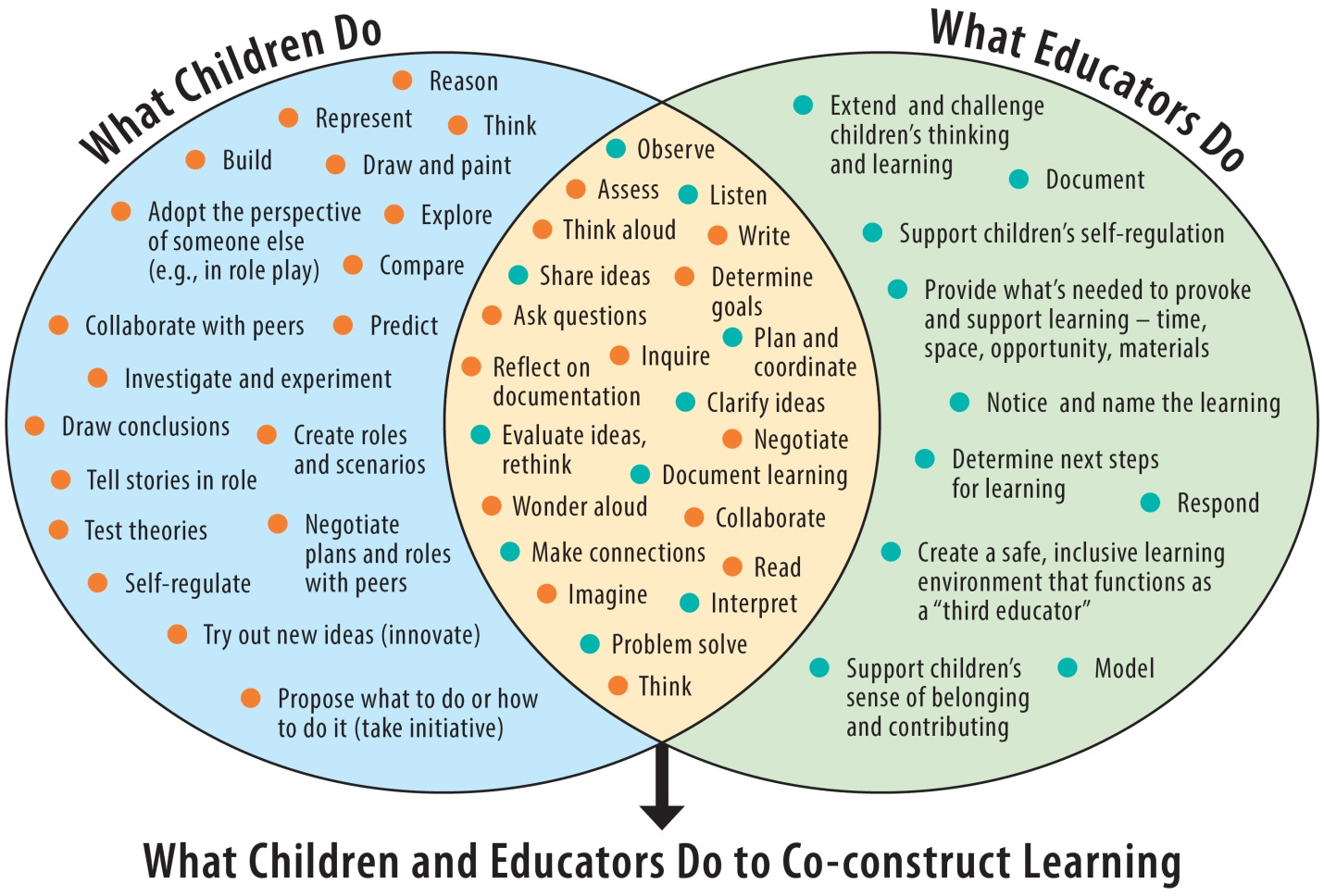
This is an online book published through the Ontario Ministry of Education. It is specific to Kindergarten and outlines (in over 360 pages) a kindergarten program. I read through the section specifically titled Play-based learning in a culture of inquiry for this assignment. One of the things I appreciate about this chapter is that it includes charts like this one:

As a visual learner this helps to organize my thoughts and gives me a place to start when thinking about inquiry based learning. It is such a huge topic and this Venn Diagram really breaks down some of the vocabulary I might look at more closely.

The chapter also includes links to a video series focusing on play-based learning. There is a lot of information packed into this chapter. Throughout the chapter there are links to other articles, books, videos, and the Ontario curriculum for kindergarten. It is clear that a lot of research has gone into preparing this document. It is definitely something I will use moving forward.

Inquiry-Based Learning: Preparing Young Learners for the Demands of the 21st Century

In this article the authors look at inquiry based learning as a way to create learners who are "the problem solvers, researchers and critical thinkers of the 21st century." The article states that the jobs of the future will need young people who are able to think outside the box, solve problems creatively, and share their findings with others effectively. The next section of the article defines inquiry based learning and also talks about its benefits. They then go on to document an example of an inquiry project they used which centered around worm composting in the classroom. This is a very accessible article, giving clear information, citing other research, and giving a list of further reading. The teachers involved are kindergarten teachers which gives me a clear picture of how an inquiry can be run in a kindergarten setting.

Inquiry-Based Learning: From Teacher-Guided to Student-Driven
This video shows teachers and students talking about inquiry based learning. The teachers talk about how they are implementing this type of learning in their classes. An explanation of questions they asked, and how they guide the learning is given as well. On the other side, the students are explaining what they are doing and why it works for them. I like how the teachers and students offset each other in the video with the teachers explaining an idea and then the students talking about how that idea was used in the learning. It is exciting to see how the students embraced their learning and worked together to solve problems.


Works Cited:

McDonell, Alexis. "The Super Hero Inquiry Project." The Curious Kindergarten, February 6, 2018, thecuriouskindergarten.blog/category/inquiry/

"Play-based learning in a culture of inquiry." The Kindergarten Program 2016, Queen's Printer for Ontario, 2016. The Kindergarten Program 2016. Web. 17 May 2018.

Fine, Melissa and Lindsey Desmond. "Inquiry-Based Learning: Preparing Young Learners for the Demands of the 21st Century." Educator's Voice, vol 7, April 2015, pp 2-11.  https://www.nysut.org/~/media/files/nysut/resources/2015/april/1_edvoiceviii_ch1.pdf?la=en

Edutopia. "Inquiry-Based Learning: From Teacher-Guided to Student-Driven." Online video clip. YouTube. YouTube, December 2015. Web. 18 May, 2018.

Friday, 11 May 2018

Blog Post 1 - Starting to think about direction

It's always hard to know where to start with a new project. The task for this blog post was pretty open ended so I started out by choosing a topic that was on my mind while reading the book, "Why School?: How Education Must Change When Learning and Information are Everywhere" by Will Richardson. As I read through his ideas I found myself wondering how I could implement this type of change in my current teaching assignment which is Kindergarten. As a teacher with an intermediate background it is easier for me to visualize these ideas in an intermediate setting. It was harder for me (at first) when the students are also learning to read and write. I started out searching online for "Inquiry based learning in Kindergarten" and was relieved to see that some of what was listed was actually familiar to me. The phrase "play based learning" is one that a lot of kindergarten teachers use so I was pleased to see that play based learning is part of the inquiry process. I decided that I would like to research the inquiry process as it can be applied to the world of kindergarten (and early primary) including how technology can be used during the process. In order to start sorting my thoughts I decided to create a flowchart. I wanted to focus on a few aspects of what I know about inquiry based learning and connect them to the core competencies found in the BC ed plan. I have to admit that I had a lot of fun making this chart and probably spent more time on it than I should have given the timeline of the week.
I would like to start gathering blogs from other kindergarten teachers who are talking about inquiry based learning. I realize that seeing other people's work and reading their experiences is the best way for me to learn. Seeing real examples also makes it much more likely that I will implement some of these ideas in my own class. This topic is important to me because I believe that students need to know how to find and evaluate information. The also need to be able to identify and solve problems, evaluating their own work along the way and being willing to make changes as needed. As a very new kindergarten teacher I feel that diving in to this topic will strengthen my own teaching right now as well as make it easier for me to suggest collaboration ideas with primary teachers when working in the library.