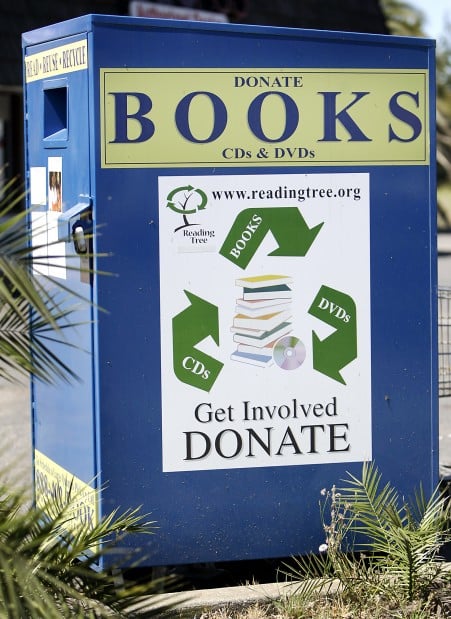
Image taken from an article in the Napa Valley Register.
Thinking about book distribution I immediately wonder how much it would cost to ship books around the world. Is there a better option? In response to this I did a quick search and found a few articles on how digital libraries are being used more and more in developing nations.

Mobile access to digital libraries in developing countries: a reflection on motives, options and sustainability
The author takes a look at how (at the time or publication) around 84% of households with access to a mobile phones. A rate much higher than that of computers. It is suggested that making libraries digital and making sure people have access to them is the way of the future.
I agree that this seems like a convenient way to bring libraries into every household. In order for this to be successful I feel like there would still need to be education in place to make sure people know how to access the libraries. Also, the people need to be literate and have access to books from a young age to build an interest in reading. Just providing the app and access is not enough.
I think the fact is that there is no easy answer to how to build, maintain, and use libraries in developing countries. We can not go in with our North American view of how things work and expect the same model to work everywhere. With that in mind I started reading about two organizations.
1. Global Libraries.
1. Global Libraries.
This organization is part of the Bill & Melinda Gates Foundation and has four areas of focus: Research and Innovation, Delivery, Training and Leadership, and Impact, Advocacy, and Policy. What immediately drew me to this organization is that they are teaching people how to use the technology as well as making it accessible. There is a focus on digital libraries but also on internet research skills. People in poor, rural, and developing areas are given access and are taught what to do with it. That is how meaningful change can take place for these people. I like that the focus is not only global but also the poor and rural close to home.
2. Library for All
I first found this organization as a Kickstarter which made me curious. They were able to raise $109,000 in 2013 towards digital libraries in developing countries. Their mission is to build digital libraries and also to educate children. They have programs in five countries using a cloud-based library platform. The website shows kids and adults learning to read, using tablets to access books. They also work with local partners to make sure the program is appropriate and sustainable. They provide easy to understand graphics like this one to encourage sponsorship (according to the website $10 can provide a child access to the digital library for a full year).


Both of these organizations resonate with me because the combine access with teaching. I love that these groups are partnering with communities, not just dumping resources. It is the best way to bring change.
If you want to read further about more charities working to bring books and libraries to the world, check out the following list:
12 Amazing Book And Literacy Charities That Are Changing The World
2. Library for All
I first found this organization as a Kickstarter which made me curious. They were able to raise $109,000 in 2013 towards digital libraries in developing countries. Their mission is to build digital libraries and also to educate children. They have programs in five countries using a cloud-based library platform. The website shows kids and adults learning to read, using tablets to access books. They also work with local partners to make sure the program is appropriate and sustainable. They provide easy to understand graphics like this one to encourage sponsorship (according to the website $10 can provide a child access to the digital library for a full year).
The Pillars of Our Library - taken from the Library for All website
Both of these organizations resonate with me because the combine access with teaching. I love that these groups are partnering with communities, not just dumping resources. It is the best way to bring change.
If you want to read further about more charities working to bring books and libraries to the world, check out the following list:
12 Amazing Book And Literacy Charities That Are Changing The World
Works Cited
Sousa, J. (2012). Book Donation Bin. [image] Available at: https://napavalleyregister.com/news/local/rival-boxes-collect-books-for-profit-and-donation/article_f1b5c5a2-f7bf-11e1-9e86-0019bb2963f4.html [Accessed 17 Jun. 2018].
Overdrive. (2018). [image] Available at: https://resources.overdrive.com/library/marketing-outreach/library-digital-resources/ [Accessed 17 Jun. 2018].
Barreto Da Rosa, I. and Lamas, D. (2013). Mobile access to digital libraries in developing countries: a reflection on motives, options, and sustainabiity. [online] ResearchGate. Available at: https://www.researchgate.net/publication/259485595_Mobile_access_to_digital_libraries_in_developing_countries_a_reflection_on_motives_options_and_sustainability [Accessed 17 Jun. 2018].
Overdrive. (2018). [image] Available at: https://resources.overdrive.com/library/marketing-outreach/library-digital-resources/ [Accessed 17 Jun. 2018].
Barreto Da Rosa, I. and Lamas, D. (2013). Mobile access to digital libraries in developing countries: a reflection on motives, options, and sustainabiity. [online] ResearchGate. Available at: https://www.researchgate.net/publication/259485595_Mobile_access_to_digital_libraries_in_developing_countries_a_reflection_on_motives_options_and_sustainability [Accessed 17 Jun. 2018].
Bill & Melinda Gates Foundation. (2018). Global Libraries. [online] Available at: https://www.gatesfoundation.org/What-We-Do/Global-Development/Global-Libraries [Accessed 17 Jun. 2018].
Evans, T. (2017). Homepage. [online] Library For All. Available at: http://www.libraryforall.org/ [Accessed 18 Jun. 2018].
Weiss, A. (2015). 12 Amazing Book Charities Around The World. [online] Bustle. Available at: https://www.bustle.com/articles/126582-12-amazing-book-and-literacy-charities-that-are-changing-the-world [Accessed 17 Jun. 2018].

I too have put books into those blue bins, and I agree that donating used books does not seem like a very practical way to get books to other countries. I like the fact that the 2 organizations you focused on have a teaching component to them. What good are books and technology if people are not shown how to properly and practically use them?
ReplyDeleteI agree that just providing an app is not access enough for those in developing countries. Education is needed and that requires partnering with communities, not just dumping resources. You have discussed two good organizations here who aim to do just that.
ReplyDelete