Urgent vs. Important
A Podcast Review of
Educational Leadership On The Go
Every day we make decisions regarding how we use our time. Knowing how to best prioritize the things that pull our attention will enable us to be better teachers and leaders.
In this episode of Educational Leadership On The Go titled Urgent vs Important, the hosts, Dr. Dustin Bain, Dr. Ryan Luhning, and Dr. Jaime Welborn share helpful time management information. With leadership experience in elementary, secondary, and post-secondary education, they present ideas that will resonate with all educational leaders.
Airing in August of 2019, this episode remains relevant as time management is always an important part of our success as leaders. Early in the episode the presenters offer this quote from President Eisenhower for discussion:
'What is important is seldom urgent and
what is urgent is seldom important."
-Dwight D. Eisenhower
It is mentioned that each of us may have different understandings of what is important and what is urgent. Understanding these differences will help us make decisions on how we spend our time.
Most of the podcast is spent discussing four quadrants which todays school leaders find themselves moving between using a time management matrix by Stephen Covey:
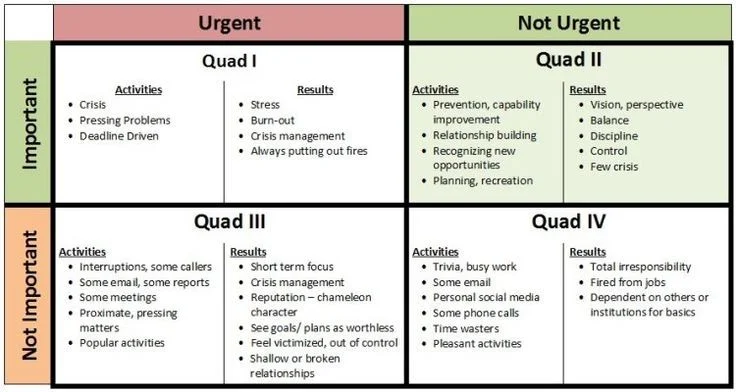
- Within this quadrant it becomes important to be able to distinguish between important and urgent
- Leaders need to balance tasks and set up systems that help with this
- If everything in your day is urgent there is no time left to lead
- Some things are important but not urgent
- Leaders need to prioritize their time
- Spending too much time in this quadrant will lead to burn out, leaders may feel that they spend all of their time putting out fires
- Leaders should spend the majority of their time in this quadrant
- Relationship building is a key function here
- Building relationships builds trust which can ease urgent matters
- There is room here to set up and implement structures which help deal with the urgent matters
- When looking at our time we can use a backwards planning approach, where do you want to be? Work backwards from there to make a plan for achievement.
- Some things, like exercise or healthy eating, are in the important zone but if they are not looked at may lead to urgent self breakdowns
- Time in this quadrant leads to creating vision and perspective in an organization
- As we go through the day our focus should be on the thing that is most important - the success of students
- To avoid spending too much time in this quadrant, leaders should delegate tasks, share the leadership
- Leaders need to work to protect the time of teachers
- Sometimes problems can become less urgent if left alone overnight. Not all emails need an immediate response
- Having a schedule for yourself is acceptable. Answering emails or calls within 24-48 hours is ok.
- If an email you are writing is longer than one paragraph you need to call instead
- Leaders need to be aware of how much time is spent here
- Spending too much time in quadrants 1 and 3 can cause leaders to burn out and end up here
- We do need to take care of ourselves and spending about 5% of our time here is healthy
- Some personalities are more prone to spending time in certain quadrants
- First year leaders will spend more time dealing with urgent matters and the lines may be blurred between urgent and important
- With experience, leaders are better able to distinguish between urgent and important
- Leaders need to build up teachers as leaders
- When we feel stress we should take time to reflect on what is happening
- Have a support system and understand the strengths of those around you
References:
Bain, D., Luhning, R., & Welborn, J. (2019). Urgent vs. Important [Podcast]. Retrieved 15 July 2021, from https://open.spotify.com/episode/3ijuaE4GfYYlYVQ59nRsQ9?si=Mi6oLFi3ROCS-EEfrnHzMg&dl_branch=1
Schools, T. (2017). Important vs. urgent: Stephen Covey at school — Thriving Schools. Retrieved 18 July 2021, from http://www.thrivingschools.net/blog/2017/1/30/important-vs-urgent-stephen-covey-at-school

No comments:
Post a Comment